
Armenian Flowers: A Complete Guide to Gifting by Occasion
Two flowers carry the strongest remembrance symbolism for Armenians. The forget-me-not (anmoruk) is the official emblem of Armenian Genocide commemoration, worn and displayed worldwide on April 24. The red poppy also carries deep remembrance associations — in Armenian poetry and visual art, poppies symbolise the blood of those lost and the obligation of memory. Where the forget-me-not says “I remember,” the poppy says “I see what was taken.”
There is a moment every diaspora Armenian knows.
You are standing in a flower shop the day before a family event — a condolence visit, a wedding, a grandmother’s name day — and you are holding two bunches of flowers that both look fine, and you have absolutely no idea which one your family would find right. You know flowers matter in Armenian culture. You have seen that your whole life. You just were never told the rules.
This post is those rules. It covers the Armenian flowers that carry real cultural meaning, the occasions they belong to, and the specific Armenian symbolism your family already knows but may never have explained to you. Whether you are navigating a wedding in Yerevan or sending something meaningful to a relative in Glendale, this guide tells you exactly what to give, and why.
What Makes a Flower Armenian? The History Behind the Gifting Tradition
The Armenian relationship with flowers is not decorative. It is devotional.
In ancient Armenia — before Christianity arrived in 301 AD — flowers were offerings to gods. The goddess Astghik, patron of love, beauty, and water, was worshipped with bouquets of roses. Her festival, Vardavar, is where the Armenian word for rose comes from: vard (վարդ). It is one of the oldest flower-gift traditions in the world, and it is still celebrated today, 98 days after Easter, when Armenians drench each other with water and exchange roses in towns and cities from Yerevan to Glendale, California.
When Armenia became Christian, the flowers did not disappear. They absorbed new meaning. Roses moved from pagan temple offerings to tokens of love and respect at every family gathering. The forget-me-not became the emblem of the Armenian Genocide centennial in 2015. The apricot blossom became the unofficial symbol of homeland longing, because every Armenian who has ever left Armenia carries a memory of those white-pink flowers blooming on the tsiran tree in spring.
This is the context you carry into a flower shop. In Armenian culture, flowers speak in a language your family learned before you were born. This guide teaches you that language.
[IMAGE: Close-up of a fresh red rose against an Armenian mountainous landscape background. Alt text: “Armenian flowers — red roses as traditional gifting flowers in Armenian culture”. Caption: The rose has been Armenia’s most symbolically significant gifting flower since the pagan era, when offerings of vard were made to the goddess Astghik.]
The Language of Flowers in Armenia: What Each Bloom Communicates
Armenians love presenting fruit baskets as wellness gifts but they also do not give flowers randomly. Colour, type, and quantity all carry information. Here is what the most common gifting flowers communicate in Armenian cultural context.
Roses (Vard — Վարդ): The most universally appropriate gifting flower across all occasions. Red roses communicate love and passion — they are the dominant choice for romantic occasions and are the flower most historically tied to Armenian mythology through Astghik. Pink roses and mixed rose bouquets are appropriate for birthdays, women’s celebrations, and family visits. Importantly, red roses are also used in funeral arrangements in Armenia — unlike some Western contexts where red is avoided at funerals, Armenian tradition is more inclusive in its use of red.
Tulips: Particularly beloved in Armenia in yellow and red varieties. Tulips are a spring flower and carry strong associations with renewal and femininity. They are the signature flower of International Women’s Day celebrations — one of the heaviest flower-gifting occasions in the Armenian calendar. A bouquet of yellow and red tulips brought to an Armenian woman on March 8 is always right.
Gerbera Daisies: Bright, cheerful, and considered the ideal birthday flower in contemporary Armenian gifting culture. Gerberas are often mixed with roses or lilies for celebratory arrangements and are considered appropriate across a wide age range.
Carnations: Long-lasting and fragrant, carnations appear heavily in both celebratory and funeral arrangements in Armenia. White carnations are strongly associated with sympathy and condolence, while red and pink carnations belong to celebrations.
Lilies: The primary flower for condolence and funeral arrangements. White lilies with roses are the standard choice when expressing sympathy for the loss of a young person. Pink lilies are typically chosen for the funeral of a woman. Lilies are not generally brought as celebratory gifts — if you are attending a birthday or a wedding, leave the lilies for the florist making funeral arrangements.
Wildflowers (chamomile, lavender, wildflowers of the Caucasus): Increasingly popular as part of bouquet arrangements for weddings and anniversaries, particularly among younger Armenians who want to reference the natural landscape of Armenia. Mixed wildflower bouquets feel culturally specific in a way that a generic rose arrangement does not.
[IMAGE: An arranged bouquet of mixed tulips, roses, and gerberas in red, pink, and yellow. Alt text: “armenian flowers gift bouquet tulips roses gerberas for Women’s Day or birthday”. Caption: This combination — tulips, roses, and gerbera daisies — is the most common celebratory bouquet in Armenian flower culture for birthdays and Women’s Day.]
Armenian Flowers by Occasion: The Gifting Calendar
The clearest way to understand Armenian flower gifting is to follow the occasions. Here is when flowers are given, what is given, and what it communicates.
Women’s Month: March 8 — The Biggest Flower-Gifting Day of the Year
In Armenia, International Women’s Day (March 8) is not a single day — it is the beginning of what Armenians call Women’s Month, a period running from March 8 through April 7. Every corner of Yerevan fills with flowers during this stretch. It is the single highest-volume flower-gifting period in the Armenian calendar.
Tulips — particularly yellow and red varieties — are the defining flower of this occasion. They arrive in enormous quantities from early March, sold by vendors on every street in Yerevan and in Armenian neighbourhoods in Glendale, Watertown, and Paris. Roses, gerbera daisies, and mixed spring bouquets are also common. Snowdrops hold particular symbolic weight in this period as the first flower to appear after winter — in Armenian culture they are called the snow flower, and they mark the return of warmth with a specific kind of emotional resonance that a tulip cannot replicate.
For diaspora Armenians: if you are visiting an Armenian household in March, bring flowers. It is not optional. It is expected with love.
Armenian Weddings: Roses, Irises, and the Wild Poppies of the Caucasus
Armenian weddings are grand celebrations where flowers represent the beginning of a new life and the joining of two families. Roses, lilies, and irises are classical choices — signs of love and purity — while wildflowers like poppies and wild irises bring a touch of the Armenian natural landscape into the ceremony.
The bride’s bouquet in traditional Armenian weddings most commonly features white or cream roses, often mixed with lilies or greenery. Guests bringing flowers to an Armenian wedding should choose bright, celebratory arrangements — deep reds, pinks, and whites. Avoid yellow-only bouquets, which are associated in many Armenian families with sorrow rather than celebration.
One gesture particularly resonant with older-generation Armenians: bringing flowers specifically to the mother of the bride or the mother of the groom at an Armenian wedding. She has worked harder than anyone for this day. Acknowledging that with flowers is culturally astute in a way that most wedding gift guides do not mention.
Birthdays: The Rule of Odd Numbers
In Armenian (and broader post-Soviet) flower culture, bouquets given as gifts must always contain an odd number of stems. Even numbers are strictly for funerals. This is not superstition so much as cultural vocabulary — giving an even-numbered bouquet at a birthday is like arriving in black. The specific number matters less than the principle: 7, 9, 11, 15 — always odd for celebrations.
[IMAGE: A bouquet of 9 pink roses being presented as a birthday gift. Alt text: “armenian birthday flowers odd number rose bouquet gifting tradition”. Caption: The odd-number rule for celebratory bouquets is one of the most consistent conventions across Armenian, Russian, and broader Caucasian gifting culture.]
Condolence and Funeral Flowers: What to Bring to an Armenian Keerk
The Armenian wake — called a keerk — is held the night before burial, typically at the family’s home. The deceased traditionally lies in repose in an open casket, often adorned with flowers, while candles are lit symbolizing eternal light.
Arrangements of white lilies and roses are most appropriate when a young person has passed. Pink lilies and pink roses are the standard choice for the funeral of a woman. For a man, yellow flowers arranged simply and elegantly are conventional.
Unlike celebratory bouquets, funeral flowers in Armenian tradition follow even numbers — or are given as formal arrangements rather than counted bouquets. Carnations are an especially appropriate condolence flower because of their long-lasting fragrance, meaningful in a multi-day funeral proceeding.
One thing diaspora Armenians sometimes get wrong: in Armenian funeral tradition, flowers should be delivered before the funeral begins, not brought in hand during the ceremony. If you are attending an Armenian funeral, arrange delivery to the family home in advance, or bring flowers to the keerk the evening before.
The Armenian National Flower: The Forget-Me-Not and What It Carries
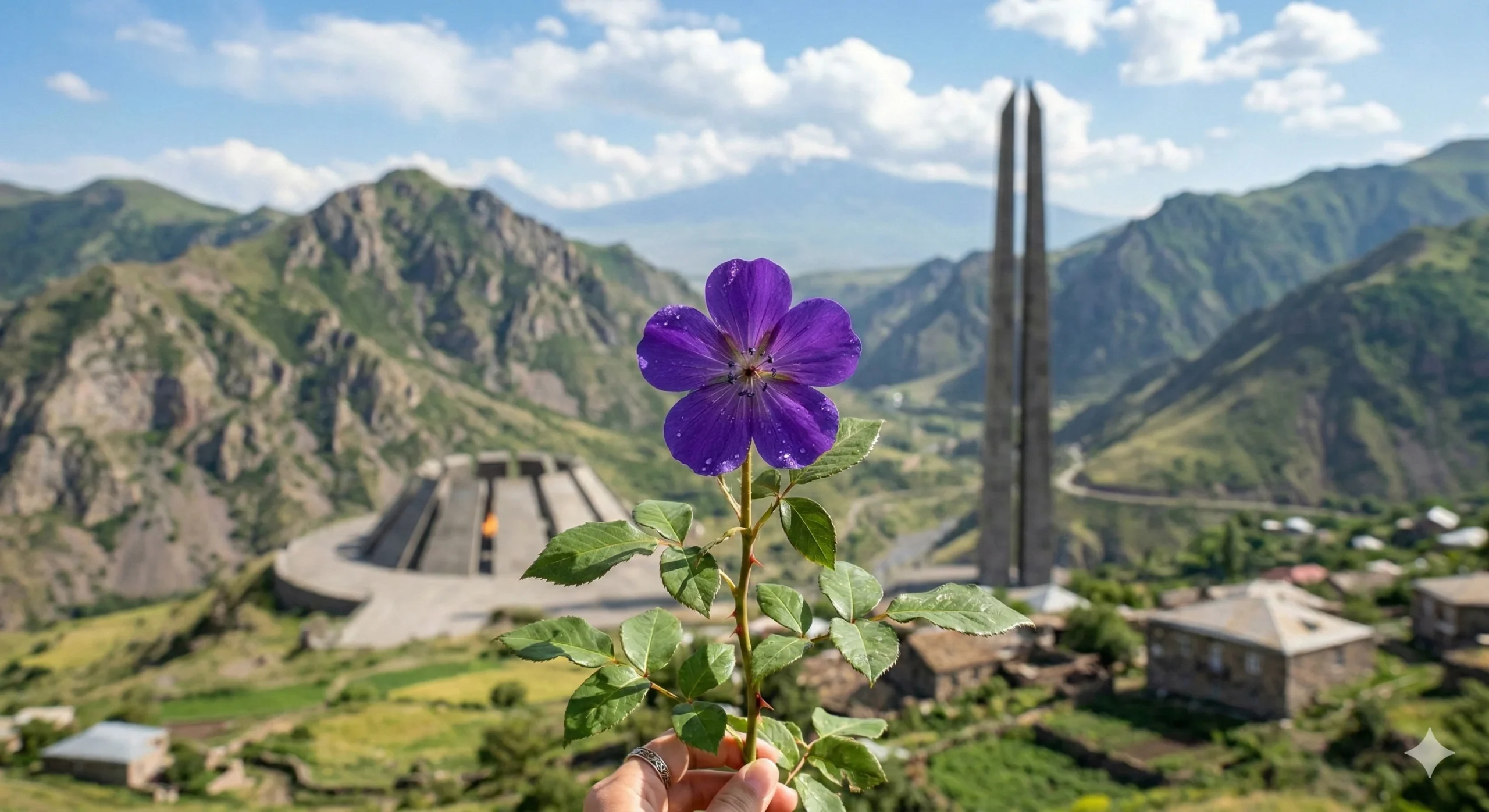
The national flower of Armenia is the forget-me-not — called anmoruk (անմոռուկ) in Armenian, meaning “do not forget.”
It became the official emblem of the Armenian Genocide centennial in 2015, and every detail of the design was deliberate. The five petals represent the five continents where Armenian diaspora communities found refuge after the genocide. The purple colour reflects the connection between the Armenian Apostolic Church and the nation’s spiritual identity. The black centre symbolises the suffering of 1915. The yellow inner core represents the light of justice and the hope for global recognition.
Fourteen varieties of forget-me-not grow naturally in Armenia, blooming from spring through August in forests across nearly every region of the country.
For diaspora Armenians, the anmoruk is not simply a national flower. It is a flower that holds the entire weight of diaspora identity in five purple petals. In diaspora homes, flowers often stand in for landscapes left behind. This is particularly true of the forget-me-not, which appears on jewelry, memorial badges, and in remembrance ceremonies on April 24 worldwide.
If you are looking for a flower that means something profound to an Armenian elder — a grandmother born in Lebanon or Beirut, a grandfather who grew up in the aftermath of 1915 — the forget-me-not is not merely a flower. It is a statement of memory and solidarity.
Vardavar: The Ancient Armenian Rose Festival (And Why Vard Means Everything)
Every Armenian who grew up in an Armenian household has been splashed with water in summer without knowing exactly why.
Vardavar (Վարդավառ) is one of the oldest living festivals in the world. It predates Christianity in Armenia by thousands of years. The festival is celebrated 98 days after Easter, when people of all ages drench each other with water across Armenia and in diaspora communities including Glendale, California.
Originally dedicated to Astghik, the ancient Armenian goddess of love, beauty, and water, the festival symbolizes fertility, rebirth, and nature’s blessings. Roses — Astghik’s sacred flower — were offered in her honour, and people poured water over one another as a ritual of purification and celebration.
According to legend, Astghik showered roses from the sky and endowed Armenian girls with unearthly beauty. Rose in Armenian is vard, and Vardavar was one of the most beloved holidays of pagan Armenians.
The red rose’s origin in Armenian mythology is particularly striking. When Astghik’s beloved Vahagn was injured in a struggle with evil, she rushed barefoot across a field of roses to help him, injuring her feet along the way — her blood turned the roses red, and this is how the red rose came to be, in the Armenian telling.
This is why vard — the Armenian word for rose — carries a weight in Armenian culture that no other flower does. When an Armenian grandmother receives a bouquet of red roses, she is receiving a flower whose mythology her people have been telling for three thousand years.
The Cultural Weight Armenians Carry Into Every Flower Shop
There is something worth saying plainly, for the diaspora reader who may feel distanced from all of this.
You do not have to know every piece of this history to give flowers meaningfully. But knowing some of it changes what it feels like to hold a bunch of tulips in March, or to place a forget-me-not pin on a lapel on April 24, or to bring white carnations to an Armenian family who has just lost someone.
Armenians have been gifting flowers through exile, through genocide, through diaspora, through the particular grief of being scattered across five continents with no homeland to return to and a homeland to return to simultaneously. Flowers carved into khachkars — the Armenian cross-stones — symbolize life growing from faith and stone. For Armenians living far from the homeland, flowers often become emotional anchors.
The diaspora experience is one of carrying culture without a container. You carry it in food, in language, in the specific smell of your grandmother’s kitchen — and you carry it in the flowers you bring to the right occasions at the right times. That is not a small thing.
Every flower you give according to this tradition is a vote for the culture’s survival.
The Gifting Bridge: Flowers as the Original Armenian Edible Gift
There is a reason Booqart exists at the intersection of flowers and food.
In Armenian culture, gifting flowers and gifting food are not separate traditions — they are two expressions of the same impulse: to bring something of the earth, something grown, something alive, into another person’s home as an act of care.
The edible bouquet is the most literal fusion of these two impulses. The same aesthetic sensibility that makes an Armenian bride’s bouquet of white roses and wildflowers beautiful is what makes a beautifully arranged fruit and chocolate arrangement a meaningful gift. Both are arrangements of natural things, composed with intention, given at moments that matter.
Understanding what flowers mean in Armenian culture is part of understanding the full spectrum of Armenian gifting traditions — from the roses brought to a keerk, to the dried fruit placed on a New Year table, to the edible arrangements that honour the tradition of gifting food meaningfully on every occasion that marks a life.
To understand the full breadth of that tradition, explore the complete guide to Armenian gifting traditions — which traces how flowers, food, and produce have always been the language of love in Armenian households.
FAQ: Armenian Flowers and Gifting — Your Questions Answered
What is the national flower of Armenia? The forget-me-not, called anmoruk (անմոռուկ) in Armenian, is the national flower of Armenia. It was chosen as the official emblem of the Armenian Genocide centennial in 2015. Its five purple petals represent the five continents where Armenian survivors scattered after 1915, forming the global diaspora. It blooms naturally across nearly all regions of Armenia from spring through August.
What does “vard” mean in Armenian? Vard (վարդ) is the Armenian word for rose. It is also the root of Vardavar, the ancient Armenian festival held 98 days after Easter, when roses were traditionally offered to the goddess Astghik as celebrations of love and the harvest. The word vard is one of the most ancient flower names still in daily use among Armenians worldwide.
What flowers are appropriate for an Armenian funeral? White lilies and white roses are the standard Armenian funeral flowers, especially for the loss of a young person. Pink lilies and roses are conventional for a woman; yellow flowers arranged simply are appropriate for a man. Always bring an even number of stems, or send a formal arrangement rather than a counted bouquet. Deliver flowers before the funeral, ideally to the family home the evening of the keerk rather than the day of the burial.
What flowers do Armenians use at weddings? Armenian weddings most commonly feature roses, lilies, and irises in the bride’s bouquet and centrepieces, as these symbolise love and purity. Wildflowers — particularly poppies and wild irises — are increasingly included to reference Armenia’s natural landscape. For guests bringing flowers, choose bright celebratory arrangements in red, pink, or white. Avoid yellow-only bouquets, which carry associations with sorrow in Armenian culture.
What is the most important flower-gifting occasion in Armenia? International Women’s Day on March 8 triggers the single largest flower-gifting period in the Armenian calendar, known as Women’s Month and celebrated through April 7. Tulips — especially yellow and red — are the defining flower of this occasion. Roses, gerbera daisies, and snowdrops are also common. Men in Armenia purchase flowers for wives, mothers, sisters, colleagues, and teachers throughout this period. In diaspora communities, this tradition continues with the same intensity.
Is it appropriate to send flowers to Armenia from abroad? Yes. Several reliable delivery services operate across Armenia including to Yerevan, Gyumri, and Vanadzor. The most culturally considered approach is to send flowers appropriate to the specific occasion — tulips for Women’s Day, white lilies for condolence, roses for birthdays or celebrations. The odd-number rule applies: celebratory bouquets should contain an odd number of stems.
What flowers symbolise remembrance in Armenian culture? Two flowers carry the strongest remembrance symbolism for Armenians. The forget-me-not (anmoruk) is the official emblem of Armenian Genocide commemoration, worn and displayed worldwide on April 24. The red poppy also carries deep remembrance associations — in Armenian poetry and visual art, poppies symbolise the blood of those lost and the obligation of memory. Where the forget-me-not says “I remember,” the poppy says “I see what was taken.”
Conclusion: The Flower as a First Language
Long before Armenians had to explain themselves to anyone, they were communicating through flowers.
The rose offered to Astghik, the tulips brought to a mother in March, the white lilies placed beside an open casket, the forget-me-not pinned to a lapel every April 24 — these are not separate acts. They are variations of the same sentence: I see you. I am here. This matters.
For the diaspora Armenian standing in a flower shop trying to get it right before a family event, the knowledge in this guide is not trivia. It is cultural fluency — the kind your grandparents assumed their children would absorb and their grandchildren sometimes did not.
Explore how this same language of giving extends beyond flowers to every precious Armenian produce and food gift in the complete guide to Armenian gifting traditions — because for Armenians, everything that grows has always had somewhere important to go.
The flowers your family gives are not beautiful by accident. They are beautiful on purpose, carrying a meaning that survived everything Armenia survived.
That is worth knowing by name.
